Industries
Industries
By Dusaw Team
How apartment building entry systems fit together, from the lobby intercom and resident credentials to amenity doors and unit locks, plus the code and planning questions to settle before you buy.
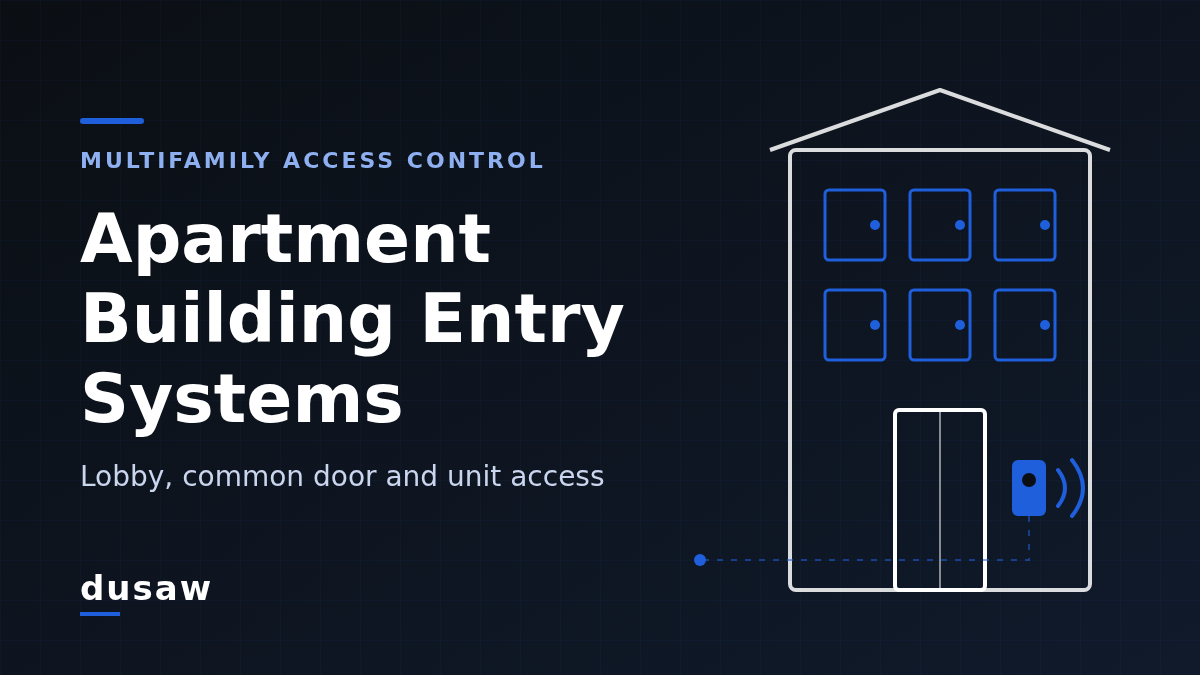
An apartment building has more doors than most people count: the street entrance, a vestibule or lobby door, parking gates, stairwells, the mailroom, the package room, the gym, the roof, and every unit. An apartment building entry system is the set of hardware and software that decides who gets through each of those doors, when, and how that decision is recorded. This guide breaks the system into its layers, explains how credentials move between them, and lists what to check before you sign a contract for new construction or a retrofit.
Most buildings end up with three layers, often from different vendors. Treating them as one system from the start avoids the most common problem: a resident who needs a fob for the lobby, a code for the package room and a metal key for their unit.
Perimeter and lobby entry: the front door, vestibule, garage and gates. This is where visitors arrive, so it usually combines an intercom or video intercom with a reader or keypad for residents.
Common and amenity doors: mailrooms, package rooms, gyms, laundry, storage cages, rooftops and back offices. These doors need resident-specific or role-specific access and a usable audit trail.
Unit doors: the residential lock on each apartment. This is where turnover, lockouts and maintenance entry happen every day.
The software that sits above these layers is what makes the hardware manageable: it holds the resident list, issues and revokes credentials, sets schedules, and keeps opening records.
Search results for apartment building door entry systems are dominated by intercoms, but an intercom and an access control system solve different problems.
An intercom lets a visitor contact a resident, and lets that resident release the door. Video intercom systems for apartment buildings add a camera so the resident sees who is calling. Many newer units can also call a resident's phone instead of a wired handset. The intercom answers the question "who is at the door right now?" but it rarely manages residents' own credentials well.
Access control answers "who is allowed through this door, and when?" Residents, staff, vendors and delivery drivers each get a credential with a schedule. The building can then revoke a single person without changing anything for anyone else, and review who opened which door.
In practice, the lobby needs both: an intercom for visitors and a credential reader or electronic lock for residents. Amenity and unit doors need access control, not intercoms.
The credential is what residents carry, so it shapes the daily experience more than any other choice. Keyless entry for apartment buildings usually means one of the following, or a mix of them.
RFID fobs and cards are cheap to replace, fast at the door and familiar to residents. Our guide to key fob entry systems for apartment buildings covers fob technology and handling in detail.
Mobile keys remove plastic from the process. With Dusaw, a mobile key can be sent as a link that opens in the browser (no app needed; remote unlock requires Dusaw network hubs at the property) or used in the Dusaw app with Bluetooth when the resident is standing at the lock.
PIN codes are useful for deliveries and vendors because each person can get an individual, trackable code instead of a shared one.
Whatever you choose, aim for one credential per resident that works on every door they are entitled to use. A building that issues a fob for the front door and a separate key for the unit doubles the work at every move-in and move-out.
How credentials are managed matters as much as the credential type. Dusaw supports two models, and the difference affects how much staff time an apartment building entry system consumes.
The card or fob is written at an encoder in the leasing office. Changing what the credential can open, or extending it, means bringing it back to the desk to re-encode.
With Dusaw Access, credentials are not encoded. Each card's unique signature is registered on specific locks, so staff can reassign a card to another unit, change its validity or disable it remotely. This requires Dusaw network hubs (gateways) at the property. For buildings with frequent turnover or many shared doors, this is where most of the operational savings come from. The multifamily keyless entry systems guide compares the two models day to day.
A building keyless entry system at the lobby or garage usually means wired readers talking to a door controller. According to the Security Industry Association, the Open Supervised Device Protocol (OSDP) is an open standard for communication between access control panels and readers that supports bidirectional communication, continuous supervision of the wiring and AES-128 Secure Channel encryption, as an alternative to the legacy Wiegand interface. If an integrator is specifying new readers, ask whether they will run OSDP with Secure Channel enabled.
Entry systems control the way in; codes control the way out. Before any electronic lock goes on a corridor, stair, lobby or exit door, involve the local authority having jurisdiction.
Free egress. According to UL Solutions, the International Building Code and NFPA 101 Life Safety Code generally require doors to open readily from the egress side without keys, tools or special knowledge, and integration with fire detection systems and loss-of-power behaviour (fail safe vs. fail secure) are among the factors to consider for electrically locked doors.
Unit doors. According to the Builders Hardware Manufacturers Association's summary of the 2024 edition of NFPA 101, doors from individual living units may require no more than two releasing motions, which is what permits a deadbolt in addition to a lever latch.
Listed hardware. The same BHMA summary notes that NFPA 101 allows electrical locking hardware to be listed to UL 294 (Access Control System Units) or UL 1034. UL Solutions describes UL 294 as defining minimum construction, performance and operational requirements for electronic and electromechanical access control systems.
Accessibility. The 2010 ADA Standards for Accessible Design require door hardware to be operable with one hand without tight grasping, pinching or twisting of the wrist, mounted 34 to 48 inches above the floor. Lever trim and readers placed within that range satisfy both residents and inspectors.
Apartment-specific security practices, including fire doors and key control, are covered in our apartment building security guide for property managers.
Most entry-system complaints come from people who are not residents.
Deliveries: give carriers and couriers individual passcodes or time-limited credentials to the lobby and package room, so every delivery is logged against a name.
Vendors and maintenance: schedule access to the doors and hours a job requires, and let a property manager unlock a door remotely for an emergency visit.
Guests: route them through the intercom, or send a time-limited mobile key for a planned visit.
For new apartment developments, run conduit and power to every reader and gate location during rough-in, and coordinate door hardware with the access control design before doors are ordered. For existing buildings, the deciding factor is usually the doors themselves. Dusaw locks are designed to retrofit to existing door preparations, which keeps unit and amenity upgrades from turning into door replacements.
Can one resident credential open the lobby, amenity doors and their unit?
Can staff revoke or reassign a credential without the resident coming to the office?
Does the platform integrate with your property management software? Check the vendor's published list, such as the Dusaw integrations page.
Who receives low-battery and offline alerts? With Dusaw, low-battery warnings go to the property administrator.
What are the recurring fees per door, per unit or per user, and what happens if you stop paying them?
Which components are listed to UL 294, and does the design meet your local egress code?
A good apartment building entry system is not a single box at the front door. It is an intercom for visitors, access control for residents and staff, and unit locks that all share one credential and one resident list. Start with the doors residents use every day, choose a credential model your staff can manage, and confirm life-safety requirements early. To plan unit and common-door access for your property, see Dusaw for multifamily or request a quote.
It is the combination of hardware and software that controls who can open a building's doors, from the lobby and garage to amenity rooms and individual units. It usually pairs an intercom for visitors with access control credentials for residents and staff.
No. An intercom lets a visitor contact a resident who can release the door, while access control issues each resident, staff member or vendor a credential with its own schedule and keeps a record of openings. Most apartment lobbies need both.
The best option is one credential per resident, such as an RFID fob, card or mobile key, that works on every door they are allowed to use. Choose a system that lets staff revoke or reassign credentials without the resident visiting the office.
Yes, with mobile keys. With Dusaw, a mobile key can be opened as a browser link for remote unlock, which requires Dusaw network hubs, or used in the Dusaw app over Bluetooth when the resident is at the lock.
Yes. Model codes such as NFPA 101 and the International Building Code require free egress from the inside, and electrically locked egress doors have specific requirements, so confirm the design with your local authority having jurisdiction.
Give each carrier or courier an individual passcode or time-limited credential for the lobby and package room. Every delivery is then logged against a name instead of a shared code.